
What does the Curriculum and Assessment review actually mean for us? A focus on Art and Design
Today I want to focus on primary Art and Design. It’s a small section within the review, but nonetheless, it touches on a couple of things that have come up in other subject areas too.
“The current Key Stage 1 to 3 Programmes of Study offer flexibility and autonomy, which are valued by many art teachers.” (p56). This is something that I agree with wholeheartedly – art and design should be about creativity and allowing teachers to explore different artists, techniques and media in the way that works best for their children is so important. However, there is always a flip-side, and in this case, like in other subject areas, teachers want more clarification in terms of what needs to be taught within the subject discipline. This seems to be a bit of a recurring theme and is something that has come up in discussions I have had recently with teachers and leaders in schools. Whilst autonomy is great, the time it takes to develop and construct an entire curriculum area (in some cases from scratch), is time consuming and requires someone with the right subject knowledge. Art and design is a subject area where many children aren’t confident, and if teachers aren’t confident either, teaching and learning won’t be effective.
Let’s explore the review in more detail.
What does the Curriculum and Assessment Review actually say about primary Art and Design?
The review celebrates the ‘flexibility and autonomy’ that is afforded by the current curriculum. But as I’ve already talked about, there are challenges that come with this, and it is important that we have an understanding of the knowledge and skills that we need to teach our children. The review refers to the need to make changes to the National Curriculum “to clarify the knowledge and skills that pupils are expected to develop. Any revisions should be relatively minimal, retaining the aims of the current Art and Design curriculum and maintaining its focus on creativity.” (p56) Again, this is a recurring theme – revisions should be minimal – again backing up this idea of evolution not revolution. And I think this is a good thing, a bit of additional clarification for those that need it, but autonomy, freedom and creativity remains so that we can continue to inspire children in their art learning.
The review highlights some key elements that would support these refinements:
· “the current curriculum could do more to articulate how students’ practical knowledge and skills should progress throughout their study” (p56)
· “to include more detail on using alternative media to meet concerns about a narrow focus on drawing and painting in many settings.” (p56)
The first point looks rightly at progression. How do knowledge and skills develop progressively across year groups? Currently, schools are figuring out what this looks like on their own, but with a bit of guidance, this could be made more consistent across the country. I think this would benefit both staff and children when having curriculum discussions around the subject area and developing creative experiences to support the children’s learning.
With regard to the second point, I think this is just as important. Where subject leaders and teachers are secure in their knowledge of art and design, the media used will be drawn from a bigger range and provide children with great experiences of different ways of creating pieces of art. Where this subject knowledge is less, teachers will tend to stick to a more limited range within what they know, inadvertently narrowing the art curriculum and not exposing children to the vast range of potential experiences that are available to explore.
The government’s response
Here’s a copy of the government’s response to art and design:
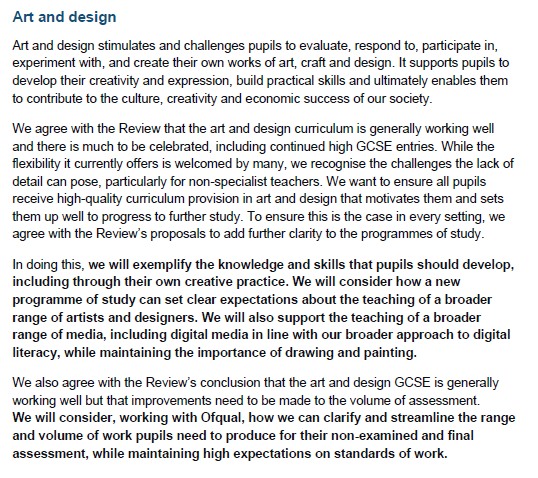
I think the most significant part of what the response to art and design highlights is something which I think is extremely important to acknowledge for primary school teachers. We are expected to be experts across ten plus subject areas. The reality of this is that it is not a realistic possibility, and art and design can often fall victim to this as a subject area where teachers subject knowledge is more limited – this is not a criticism by any means, but would apply to any subject area and this will be different for each teacher. Adding further detail would be a welcome development I think, in terms of setting out clearly the breakdown of knowledge and skills and how to utilise them across different media.

So what does this mean for subject leaders and classroom teachers?
In terms of what to do in the now, I think the message, as with the other subjects I’ve looked at, is nothing drastic. I think most schools try to deliver an interesting art curriculum that draws on creativity and looks to develop art and design skills. But it is going to be a while before the new NC is written and released, and as a subject/curriculum leader or SLT, I would consider these key questions:
· Are you and your staff clear on the progression of knowledge and skills?
· As part of the art and design curriculum, do you provide children with the experience of a range of media and different artists to broaden their knowledge in a balanced and well rounded way?
· Are staff given the right opportunities to develop their own subject knowledge around the art that they are expected to teach?
Hopefully, when the new NC arrives, the first two of those questions will be addressed effectively and that this will result in a more consistent approach to art and design across settings. It may even go some way to supporting with that third question too. However, we’re not there yet, and we honestly don’t know what that will look like. My advice would be that if you can answer those three questions effectively, then you are on the right track and should continue doing what you are doing. If you’re struggling with any of those questions, as always, you can see below for resources that may support you in your work.
Feel free to explore the links below:
A short blog by Clive Davies on teaching art and design:
Teaching Art in the Curriculum – Focus Education
A publication by Clive Davis, including progression mapping and overviews for units of learning:
Developing a Curriculum for Art and Design in Primary Schools – Focus Education
Knowledge organisers for units in art and design:
Art & Design Knowledge Organisers – Focus Education
Access Art is a website where you can see overviews of key knowledge for free, but subscribe for more detailed lesson planning and ideas: