
What does the Curriculum and Assessment review actually mean for us? A focus on Science
So on we go with the curriculum and assessment review. So far, I’ve spent time looking at history and geography from a primary perspective. And today, I’m going to continue with science. I think you’ll have noticed that for the most part, a lot of what has been recorded in the review is already being worked on and developed in schools, and that, in the main, from talking to others working in and with schools, the new curriculum will just give us more clarity on some of the aspects that are less consistent across schools, like the specificity of the disciplinary knowledge that we need children to know in each subject area.
And I’m sure you’ll see some similarities in this when we look at science as a subject now too!

What does the Curriculum and Assessment Review actually say about primary science?
In the opening paragraph on science, the review states that “it is important to retain and enhance the knowledge-rich focus that has been developed.” (p112). I think that we need to start getting used to the idea of a knowledge rich curriculum if we haven’t already. Most schools build their curriculum around the knowledge we want the children to know, and this is something that is clearly here to stay. Some might argue that it’s skills we need to develop, and I think there are lots of ‘life-skills’ that should be more involved in curriculum thinking, but for now, we’ll leave that thought here. As far as science is concerned, that skill development comes through the overarching idea of ‘working scientifically’, and this is where the disciplinary knowledge needs to be developed to support scientific thinking and skills development.
I also found this section interesting to consider:
“…stakeholders have expressed concern that the primary Science curriculum is not taught consistently. A lack of curriculum cohesion and curriculum time for it in some schools means pupils are not able to master the content. The result is difficulties during the transition to Science at secondary school. Subject experts argued that the primary Science curriculum is unevenly distributed across the disciplines of Biology, Chemistry and Physics. Stakeholders also highlighted missed opportunities to create cross-curricular links between Science and other subjects, and between Key Stage 2 and Key Stage 3 Science, resulting in unnecessary repetition of topics at later key stages and limiting opportunities for students to build on and apply prior knowledge.” (p112)
I suppose my question would be to ask why science isn’t taught consistently across all primary schools. In terms of the detail of the content to be covered, I’d say it’s one of the more clearly organised subject areas in the NC (excluding English and maths of course). Each year group has five-ish concepts to explore, and within each, clear statements are given in terms of what is to be covered. So why aren’t science curricula in schools cohesive? I think there is a wider conversation here around prioritisation of key knowledge across all curriculum subject areas, and I think both teachers and leaders are sometimes including additional knowledge that isn’t necessarily necessary. This is not a finger point, but I mentioned when I focussed on history that we as educators sometimes try to include too much. And I think what has been noticed here in science is a symptom of the curriculum design mistakes that we are sometimes making because we feel we need to do certain things that actually, we don’t.
It goes on to talk about outlining “the essential experiences pupils should have exposure to, so that abstract scientific ideas are grounded in real life” (p113) and I think this is an interesting point to consider. In other conversations I’ve had, the subject of how digital media is taking over often comes up, and I think we need to be careful that we don’t step away from practical experiences within subject areas that are intended to be practical.
The review does highlight some key elements that it thinks should be addressed:
· It suggests that “content across all key stages should be refined and re-sequenced in line with the fundamental concepts of each scientific discipline.” (p113)
· It acknowledges “…concerns that a lack of representation of the diversity of scientists and their work can have a negative impact on pupils’ engagement and reinforce the perception that Science, and scientific careers, are not for them.” (p113-114) and that this will be looked at, but not at the expense of the key scientific concepts that should be studied.
· That practical science activities have become less frequent. However, this should be an element that is made more explicit within the curriculum in a way which isn’t just stand alone, but links with key learning in science.
· The review also comments on how “The Science curriculum currently makes only limited reference to climate science and scientific work to combat climate change, and some content in the Programme of Study is outdated.” (p115) This is something that will need some work, but there are some good cross curricular links to be made here with geography.
I think that there are some big things to think about here. The first point, we will have to be patient and see what the new curriculum has to say about it when it comes out – there’s nothing for us to do here but continue working with what we’ve got and ensuring that we sequence it progressively in the best way for the children. The fourth point regarding climate science I feel comes into this too. We can make our own links, but it will be interesting to see how this is built into the curriculum when it arrives.
The second point around diversity is important. I think it is an aspect which schools are trying to develop across the entire curriculum, not just science. I think we have to acknowledge that some aspects of science, historically, are not diverse. We have to acknowledge that, and then look at the elements that are and ensure that they are included (and not in a tokenistic way), to ensure that our young people see themselves in the science that they are studying. I agree that this should not be at the expense of key scientific principles and concepts that are studied, but when highlighting key individuals, we should look in a balanced way at the past and the present to show an accurate portrayal of life as a scientist in order to inspire our scientists of the future.
For the third point, I can’t quite believe it has to be made, but at the same time I completely understand the challenges that delivering science in a practical way can present. But this is something that schools are working to develop, in the same way as schools are looking at fieldwork in geography and developing the use of artefacts more practically in history. The point made about linking experiences directly to curriculum content is an important one though, and we should build children’s scientific investigation skills up so that they can develop a better understanding of the science they are learning about.
The government’s response
Again, I’ve copied and pasted the government’s response to science for ease:
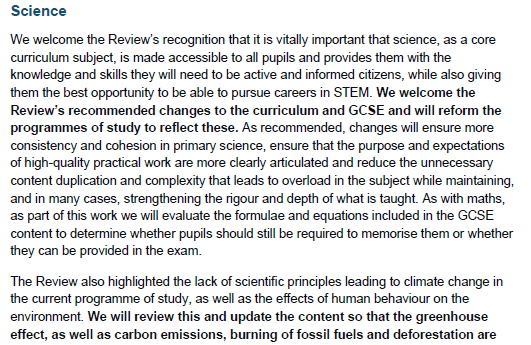
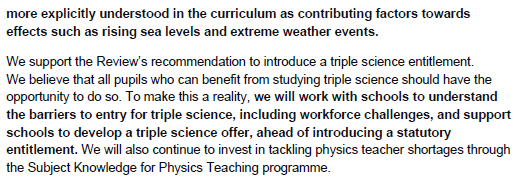
In reality, we cannot change the current programme of study. As teachers, we should continue to teach the current National Curriculum. The primary NC is set out reasonably clearly in comparison to other subject areas, and it is our job to make sure that we build in practical science and investigation to support learners with understanding the key concepts we are trying to get across. But I am intrigued to see what the new NC will look like for science in terms of rebalancing across Biology, Chemistry and Physics and building in opportunities for climate science, more explicit investigation and diversity.
So what does this mean for subject leaders and classroom teachers?
I continue to try and reassure both teachers and subject leaders, that in terms of the curriculum review, there is very little different that you need to think about doing now. As far as science goes, there are some things that we can begin to consider though, such as:
· Ensuring we teach the programme effectively by sequencing units in a way that is progressive and supports children to make links across their science learning.
· Considering what the key knowledge required actually is as set out in the NC, and teaching that well through practical science activities rather than relying on video clips to share investigations.
· Where appropriate, showing children real life examples of scientists who have changed our world and provide diverse inspiration for the scientists of the future.
I think in science, we may see some bigger changes in terms of the content than we will in history or geography. I’ve recently been working on updating the science curriculum units (soon to be released) for The Learning Challenge Curriculum and what we are trying to ensure is that purposeful, practical science supports the learning of key concepts. This is something that schools can and are working on now, but until we have the new NC, teachers and leaders should continue doing what they have been under the current NC.
There’s no need to panic or make large, whole scale changes.
And as always, if you are looking for some resources to support with this work, I’ve shared some links below:
A publication by Clive Davis, giving a range of examples of how practical investigation in science can be used purposefully:
Working Scientifically: Supporting Children's Enquiries – Focus Education
Here I’ve put together a resource to support with making the scientific investigation process more consistent across your school:
Developing the Scientific Investigation Process – Focus Education
If you are looking at how you can make greater conceptual links across science, I have a pre-recorded session available here:
Teaching Science Through Concepts (CPD Video: 2hr 2min) – Focus Education
There will also soon be a publication available on golden threads in science, which also addresses how we can use concepts to develop links across science units throughout primary school.
To support with disciplinary knowledge development too, here is a resource which is designed to support children with their understanding of what it means to be a scientist at their age and stage:
Disciplinary Knowledge Progression for Children in Science – Focus Education