
What does the Curriculum and Assessment review actually mean for us - A focus on History

I think we can all agree that there are aspects of the curriculum we would like to change or see developed further. I think examples from the Curriculum and Assessment Review that have gone down really well are things like developing a greater emphasis and framework around teaching oracy well across the curriculum or the aspects relating to developing aspects of citizenship and preparing children for real life! A bit of a shameless plug here (feel free to ignore), but these are examples of things that many schools (and education companies) across the country have been working on and putting in place for a while, such as:
Focus on Talk: A Speaking and Listening Framework – Focus Education
Which provides a framework for oracy across the primary phase and strategies around developing it effectively through our coaching model (there are free video clips too here Focus on Talk - clips )
Let's Talk: PSHCE Curriculum (BUNDLES) – Focus Education
Which provides manageable units to cover aspects of citizenship through high quality texts and real life scenarios to get the children thinking and learning about themselves, others and their community.

You’re still here after the plug?! Great. In that case, I’ll get to the point. There have been lots of blogs and social media posts about the C & A review over the last few weeks, and the resounding message is that there is nothing to do… yet. But I wanted to go a step further, and reassure you that you are probably already doing lots of the things that the review in some ways implies are ‘new’, at least from the primary perspective anyways. I’ll be going through each subject area in the wider curriculum, starting with history, and looking at what the key recommendations are and how you are probably already doing these things, or if not, there is someone who already is that can help you. So with no more ado, let’s focus in on history!
What does the Curriculum and Assessment Review actually say about primary history?
The review states that ‘the History curriculum is broadly working well’ (p84). However, it identifies some aspects that are not working so well. The call for evidence suggested:
That there is “a need to enhance students’ knowledge of how historians study the past, and how they construct historical claims, arguments and accounts.” (p84)
That the curriculum should “provide more space for exploring and embedding these disciplinary skills which are essential for further study” (p84-85)
That “there should be clearer messages about what is and what is not statutory in relation to History at Key Stages 1 to 3, and where flexibility exists in a given framework.” (p85)
“…many teachers would welcome clearer guidance and more examples to help them capitalise on existing flexibility, particularly when representing a wider range of perspectives in British History.” (p85) “…exemplification should enrich the curriculum by introducing a broader mix of perspectives and connections across different times and places, deepening students historical understanding.” (p86)
It does emphasise that any changes “should not detract from the historical and chronological understanding that is currently required across curriculum topics nor reduce the subject’s rigour.” (p85)
The review sums this up really nicely into 3 points, and essentially, the three aspects that may be developed as part of a new curriculum by 2028 are:
Making disciplinary knowledge clearer
Making the flexibility of the history curriculum clearer
Diversifying the examples and sources used in order to teach more accurately about our diverse history

The government’s response
I have copied and pasted this here for ease so you don’t have to go away and find it, but essentially, it agrees with the recommendations in a way that suggests not an awful lot will change.
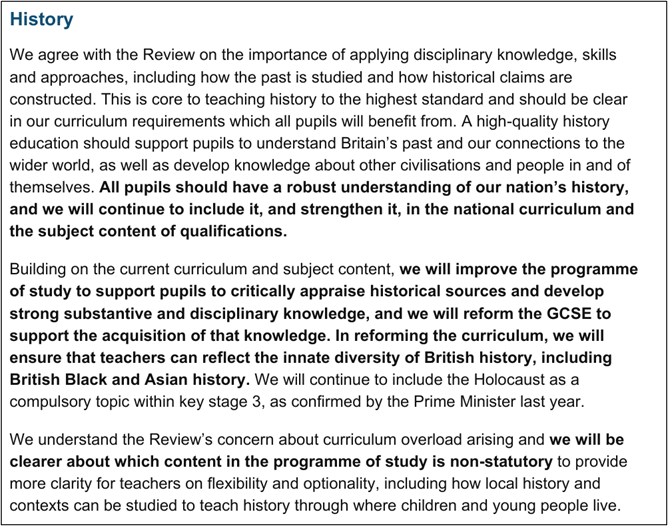
Government response to the Curriculum and Assessment Review
Substantive and disciplinary knowledge both remain important. The difference between statutory and non-statutory elements will be made clearer. It’s also suggested that the new curriculum will reflect a ‘truer’ (my word not theirs) depiction of British history which is more diverse.
So what does this mean for subject leaders and classroom teachers?
Ultimately, I want to reassure you that if you have been listening to recent discussions within education, particularly with regard to the subject of primary history, then you are probably already working on (and probably for a long time) the elements that have been highlighted in the review. Let’s take the first point:
Making disciplinary knowledge clearer:
This is something that I have been working a lot on with schools over the last 2 or 3 years as a consultant, but it is something that I worked on in schools as a leader for the years before that too. Knowing the difference between substantive and disciplinary knowledge is key, and I’ve written about that in more detail previously here - The progression question: How do I know my curriculum is progressive? – Focus Education . Schools often consider this idea in all the subjects that they teach – what does it look like to be a writer, a scientist, a mathematician, a musician, a geographer, and in this case… a historian? The disciplinary knowledge is the knowledge (or skills depending on who you talk to) that enable children to be successful in that subject area no matter the content or the context. And this is so important to history teaching, that I’m, fairly certain that most teachers will be encouraging children to look at sources of evidence, analyse them and consider the significance on our lives today. As subject leaders, you will be looking at how this looks in EYFS in understanding the world and then through KS1 and KS2 to build a progressive curriculum. This just isn’t new. But where the new NC will hopefully help us as educators, is that it will refine how this is set out so that we aren’t all looking at variations on a theme, wording things differently all the time, and concentrating on different elements. Hopefully, whilst it’s a cliché, we will be given the same hymn sheet to follow which will result in children going to high school with more consistent approaches to ‘being a historian’.
Making the flexibility of the history curriculum clearer:
This element, is something I also talk a lot about with schools. Previously, I’ve seen school curricula where there are lists of 30, 40 or even 50 pieces of knowledge that the children are expected to learn by the end of a unit of learning. This isn’t the National Curriculum’s fault, this is poor interpretation.
Everything in brackets in the NC is non-statutory. There are some great starting points in there and some elements that you’d be silly not to study within your history curriculum, but they are suggestions. Over the last couple of years, I have seen schools making great strides to refine the knowledge that they are teaching within each unit of learning. And this work is happening already. But if this is something you aren’t sure about, don’t be afraid to make contact and we can talk things through!
Diversifying the examples and sources used in order to teach more accurately about our diverse history:
If I’m honest, this is the element that I think the current National Curriculum gives us the least help with. But there are lot’s of people out there, trying to put together the knowledge and resources to support teachers with making the curriculum more diverse in a meaningful way. It shouldn’t just be tokenistic, things like celebrating Black history week are an important starting point, but the question you should be asking if you are the history subject leader is how you are taking the opportunities that present themselves to embed diversity within your history curriculum the whole year through, and there are opportunities to do this, in many of the statutory units set out by the NC.
So where does this leave us? Whilst there are always elements we can develop and improve, the things that I’m seeing in schools imply that within history, teachers and leaders are, and have been for a while, already moving in the direction that the review is suggesting. My advice is to continue doing what you are doing with history by making sure as leaders, we understand the choices you can make, that our staff understand the difference between substantive and disciplinary knowledge clearly and that you are taking the opportunity to make your history curriculum more diverse all year round.
I thought it would be good to share some things that may help you if there are elements that I’ve mentioned that you are worried about. If you’re happy, then there’s no need to read on. However, if you are looking for something to help, there are some links here to publications and resources that have been developed to make all of this a little clearer.
Making disciplinary knowledge clearer:
Making the flexibility of the history curriculum clearer:
Diversifying the examples and sources used in order to teach more accurately about our diverse history: