
What does the Curriculum and Assessment review actually mean for us? A focus on Geography
Welcome back to the world everyone. It’s been a great break over the Christmas period, but it’s back to business as we begin 2026! And as I said before Christmas, I want to take each subject area in turn so that if this is your area of responsibility, you can be really clear on the implications that the review has for us as educators and leaders. I’m going to head straight in then and look at what the review actually says about geography.

What does the Curriculum and Assessment Review actually say about primary geography?
In all honesty, over the two/three pages that are dedicated to geography in the review, there is little or no specific mention of geography at primary school. This doesn’t mean that there is nothing to take away, but largely the focus is on KS3/4 and GCSEs. However, if you read it carefully, I think there are some things that we should consider.
Firstly, there are three key areas that it highlights very strongly which I think can be looked at within Key Stages 1 and 2:
· the need to embed the concepts of climate change and sustainability as concepts within the curriculum more explicitly (without creating curriculum overload)
· establishing fieldwork more effectively in order to give children the experiences that will support their developing geographical understanding in context (allowing greater opportunities for data collection, evaluation and drawing conclusions)
· ‘embedding disciplinary knowledge more explicitly’ (p83) (this is referring to KS3 more specifically, but it is something that can easily begin in primary schools)
Each of these aspects are areas of curriculum development that I have worked on in some way over the last couple of years. The first, through my work with Clive Davies on golden threads, where we have looked at how concepts like climate and sustainability can be highlighted more effectively across the geography curriculum through KS1 and 2, without making loads more work for teachers – the idea of ‘golden threads’. This is something that lots of schools are already looking at, but of course, a more consistent approach or guidance for schools from the NC would always be welcome here.
The second then, in terms of fieldwork, is one that I think is absolutely crucial to get right if we want to teach geography effectively. We have to provide children with fieldwork opportunities across their time in primary school. It is an area which I think schools, SLTs and subject leaders are already looking at, and it’s an area which I again think we can overcomplicate. Teachers are often nervous of fieldwork and what it could mean. There’s also risk assessments and safeguarding to consider, which can be daunting for some. My opinion is that we can start small and use what’s in school for fieldwork first, building confidence up in terms of what fieldwork means and how we can embed it within units of learning more successfully.
The third point on disciplinary knowledge, again, is something that I think primary schools are already looking at and developing. We know that children need to develop their understanding of what a geographer is, and so through our teaching and use of fieldwork opportunities, schools are already focussing on this and developing children as geographers.
The government’s response
As with history, I’ve again copied and pasted the government’s response to geography for ease:
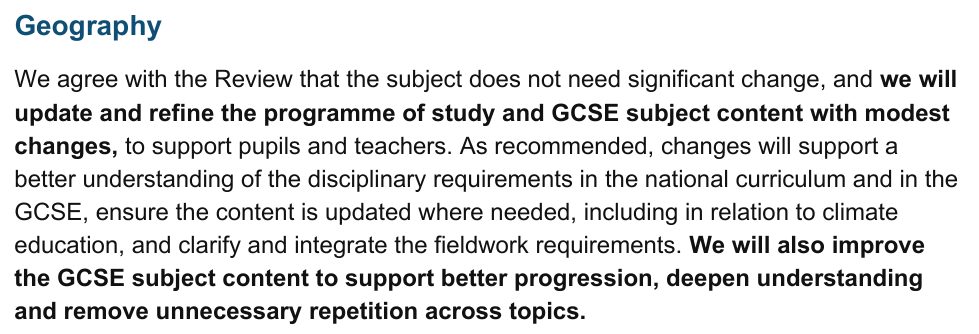
Ultimately, very little is going to change. There’s a focus on disciplinary knowledge being made clearer, and talk of refinement to the programme of study as a whole by making certain key concepts clearer such as climate change and fieldwork. But as you can see, it’s a small response and I think this demonstrates that it’ll be refinement that we are faced with as and when the new curriculum is released.
So what does this mean for subject leaders and classroom teachers?

As with history, I want to reassure you again, that you are probably already looking at the things that the review and the government have highlighted. I guess, at this point, it would be good to ask three questions of your geography curriculum:
1. Does it have any focus on key concepts, such as climate change and sustainability? (Golden threads)
2. Do the children understand what it means to be a geographer? (disciplinary knowledge)
3. Is fieldwork undertaken as a part of the process of being or becoming a geographer? (experiential learning)
In the schools that I work with regularly, these are the questions that they are considering, so for me it makes sense to assume that if you are a geography subject leader reading this, you have (or are) considering these questions too. And if so, you are ahead of the game, and simply need to keep doing what you are doing to make geography learning effective and relevant in your school.
To consider what this might look like, let’s look at each of the three areas highlighted by the review in brief:
Developing concepts:
If you look at your curriculum and the learning that takes place, you will quickly identify the geographical concepts that reoccur. This is great for so many reasons, because by identifying these concepts (things like trade, climate and sustainability), you will be supporting both teachers and children with developing learning links – points where these concepts or ‘golden threads’ are revisited throughout units, year groups and key stages, so that children can make easier reference to prior learning and embed new learning more effectively in geography.
Disciplinary knowledge:
The trick here is to understand what it means to be a geographer at each stage of learning, because what this looks like in Year 1, looks different to year 4 or year 6. But again, as with the golden threads idea, there are common threads that link everything together. And if you can set out those links progressively, building step-by-step across each year group, it becomes easier to explain to staff what it looks like to be a geographer at each stage and for them to teach it. It’s also important to explain this to children in a way that they can understand.
Fieldwork:
In order to develop fieldwork more effectively, it’s good to develop a process – one that encourages consistency across the school - so that when children approach fieldwork tasks, they know how to act as geographers and use the process to learn. It’s also important that the children are encouraged to collect and use some form of data as part of this. It could be observational or it could be data that has been researched, but they must be taught to draw conclusions from this. The best kind of fieldwork is experiential, whereby they go out and collect some form of data whether it’s within the school grounds, across different classrooms or through exploring the local area. Giving the children these experiences can encourage them to step into the shoes of a geographer and begin to become one themselves.
The review/response indicated that we may see a new curriculum in 2028, and whilst we’ve just moved from 2025 to 2026, that is still a long way off with a lot of unknowns. And ultimately, the changes to geography specifically are going to be minimal. As many are saying, there is no rush to do anything major or change tact dramatically if you are already looking at the elements I’ve discussed. And if you aren’t looking at them yet, there’s still no need to panic. You are now aware of them and can begin looking into them a little more.
And if you do want some help with any of this because you’re not quite there yet, I’ve shared some links below (feel free to ignore these if you’re already on it!):

If you haven’t started developing concept threads, I talk more about it in the following articles:
Curriculum Development - Golden Threads (HWRK Magazine)
Building a connected curriculum — New Education Outlook
I’ve also developed training on this which is recorded, and written a publication on golden threads in geography:
Teaching Geography Through Concepts (CPD Video: 2hr 1min) – Focus Education
Golden Threads in Geography: Taking your Curriculum to the Next Level – Focus Education
If its disciplinary knowledge your unsure about, there are a few things you can check out here:
Looking at Substantive and Disciplinary Knowledge within the Curriculu – Focus Education (Not specific to geography)
Disciplinary Knowledge Progression for Children in Geography – Focus Education
And in terms of developing fieldwork, there are a few things to help here too:
Geography: The art of comparison – Focus Education
Geography - Developing an Approach to Fieldwork (CPD Video: 1hr 50min) – Focus Education